How Two Partners In Suits Coordinate Without Matching

When two people are both wearing suits to a wedding, matching isn't always the answer.
Navy is the trap.
Two people choose it separately, months apart, both correctly. On the day, one looks almost black while the other has a slightly purple cast, because navy is a family rather than a single colour and shades can vary considerably between mills.
Nothing is wrong with either suit. The problem only appears when they are standing together.
Go too far in the other direction and another problem appears. Two suits cut from exactly the same cloth can look more like a uniform than two individual outfits.
The trick is to coordinate the two looks without making them identical. Colour, lapels, one repeated detail and the final proportions all matter.
Should Two Suits Match?
Not necessarily.
Matching the cloth exactly is difficult because dye lots, weaves and mills can all affect how a colour looks. Even two suits described as navy can photograph differently.
It's usually easier to choose colours that sit within the same family but have a clear difference in depth.
The same applies to the construction of the suits. The two jackets don't need to have the same lapel or silhouette. In fact, some contrast can help the outfits work better together.
One small detail can then bring the two looks back together.
How Do You Coordinate the Colours?
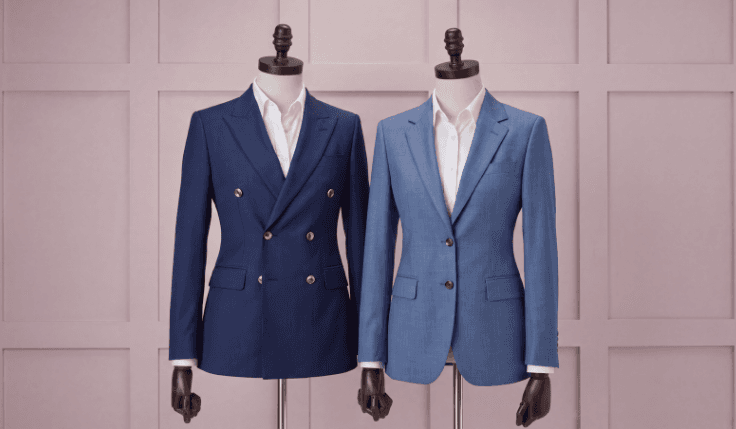
Colour depth is more useful than trying to find two cloths that match exactly.
Choose a colour family, then separate the two suits by depth.
Colour combinations that work
Ink and mid blue. The difference in depth is clear while both suits remain within the same colour family.
Charcoal and stone. Maximum separation without leaving neutral territory.
Bottle green and oatmeal. A warm pairing that photographs softer than black against white.
Chocolate and camel. Balanced in daylight, but warmer and darker under tungsten lighting, so check the venue lighting first.
Colour differences become less obvious at a distance. From across a room, differences in lightness and darkness are often more noticeable than subtle differences in hue.
If the colours are too close, the suits can look like an unsuccessful attempt to match.
Ink and mid blue usually provide clear separation. Ink and navy can photograph much more similarly, depending on the cloth and lighting.
Photography can make similar colours appear even closer. Automatic white balance can reduce some of the differences that were more obvious in person.
Should Both Suits Have the Same Lapels?
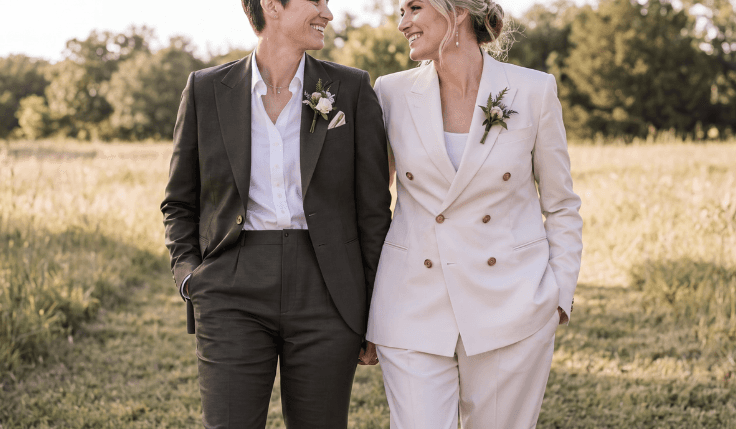
No. The cloth can provide the connection while different lapels give each suit its own silhouette.
A Freya Shawl runs one unbroken curve from collar to closure. The uninterrupted line creates a softer, more continuous shape and can work well on a sloped shoulder or fuller bust, where a notch creates a stronger visual break across the chest.
The Isadora DB creates a stronger contrast. The wrap lays one front across the other and the button stance creates a stronger horizontal line at the waist, which can make the silhouette appear squarer and the torso slightly shorter.
Side by side, the curved shawl lapel and structured double-breasted front create clear contrast without competing.
On a shorter torso, a strong horizontal line can make the torso appear shorter still. Raising the button stance slightly can restore some visual length without changing the overall cut.
These two pieces create one strong version of the pairing, but the broader principle is simply to contrast a softer curved line with a stronger structured one.
Two peak lapels, for example, can create a much more similar silhouette. Peak lapels point upward and outward, so matching peak lapels can emphasise width across both silhouettes.
Both cuts appear among the wedding jackets. Lapel width is a separate decision, and how width reads across a frame is covered in Queer Weddings and the Suit Trade That Still Misses Them.
What Detail Should Both Suits Share?
The suits don't need to be identical to have something in common.
One repeated detail is enough to connect the two without making the coordination obvious.
The detail should be subtle, but visible enough to appear in photographs.
Some options are:
Lining. Invisible until a jacket opens, creating a subtle connection when the jackets move.
Buttonhole thread. One colour repeated on both, visible mainly at close range.
Button material. Horn on both, or mother of pearl on both, even when the two suits use different cloths.
Trouser finish. Both plain hemmed or both turned up, giving both trousers the same finishing detail.
One is enough.
Repeating several details can start to make the suits look deliberately matched rather than simply coordinated.
What shouldn't be repeated?
Cloth. The same bolt on both is twinning under another name.
Lapel type. Different lapels help distinguish the two silhouettes.
Pocket square. Identical pocket square folds can make the coordination feel overly deliberate.
How Should Two Suits Fit Together?
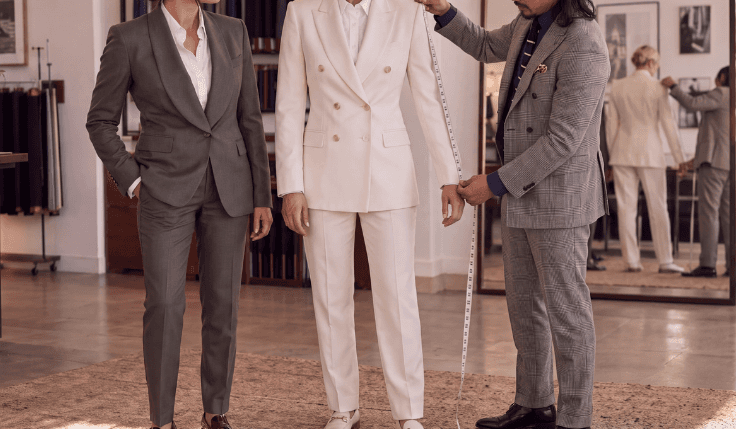
The final proportions are best checked with both people standing together.
Jacket length is determined in relation to each person's proportions, so two correctly fitted jackets may still finish at different heights when the couple stands together.
Individually, both jackets may be correctly proportioned, but the difference can become more noticeable side by side.
If an adjustment is needed, a hem alteration may be considered. Shortening a finished jacket can affect the relationship between the hem and pocket placement and make the jacket appear too short.
Trouser length needs the same side-by-side check.
The same trouser break can sit differently when one person wears heels and the other flats, so final trouser length should be checked in the shoes each person will wear on the day.
This is why the final check needs to happen with both people on their feet, rather than relying on measurements alone.
What Happens When Two People Order Custom Suits?
When two people are having suits made for the same wedding, the second fitting is where the two suits can be assessed together.
Each person has three fittings. Trunk show appointments run for sixty minutes, one on one, so a couple books two consecutive sessions rather than one long appointment.
Tell Peter what kind of lighting the venue will have.
Tungsten lighting can make browns appear warmer and more orange, while daylight shows colour more neutrally. A marquee at dusk can move between both conditions within an hour.
The process itself should also feel comfortable for both people.
Katri, who had never had anything fit properly before, described the process as effortless and quick. Deanne described Peter as calm and encouraging, which matters more than usual when two people are making decisions about each other's clothes.
Finished commissions in the customer gallery are also more useful than a swatch for judging how different colour depths photograph together.
Questions About Coordinating Two Suits
Can both suits be made at the same time?
Yes.
Appointments run one on one with Peter, so a couple books two sessions and the shared decisions can be settled across the first pair.
What if we're ordering from different cities?
Make the cloth decisions together regardless.
A commission placed at a Sydney or Auckland trunk show runs eight to twelve weeks compared with six to eight for a Melbourne studio commission, so both timelines should be planned from the wedding date.
What if we want to keep the suits a surprise from each other?
It's workable, as long as one person oversees the shared design decisions.
Peter can coordinate the colour depth and repeated detail across both commissions without either person seeing the other cloth.
One of us is wearing a dress rather than a suit. Does any of this still apply?
The colour depth rule does, and so does the repeated detail.
The lapel and jacket hem considerations no longer apply, leaving fewer elements to coordinate.
Should the wedding party pick up the same colours?
It's usually better to give the wedding party some colour separation from the couple.
Matching the exact depth of either suit can reduce the visual distinction between the couple's outfits.
Coordinating Two Suits Without Matching
Two suits don't have to match to look right together.
Start with colour. Choose a family, then give the two suits enough difference in depth to keep them distinct.
Use different lapels or jacket constructions to give each person their own silhouette.
Repeat one small detail if you want another point of connection.
Then check the finished proportions with both people standing together.
If you're planning two custom suits for your wedding, book a consultation to discuss the two looks together.